Showing posts with label Ray Kurzweil. Show all posts

March 2, 2011

Judging Computer Autonomy


Well I can say that I was satisfied with the content of my last post, but I did let a couple of issues slide past that I would have liked to address. I really let Ray have his way due to the time constraint of having to go to work. Damn work requiring its workers to be there at certain times and damn money needed to be gambled away.

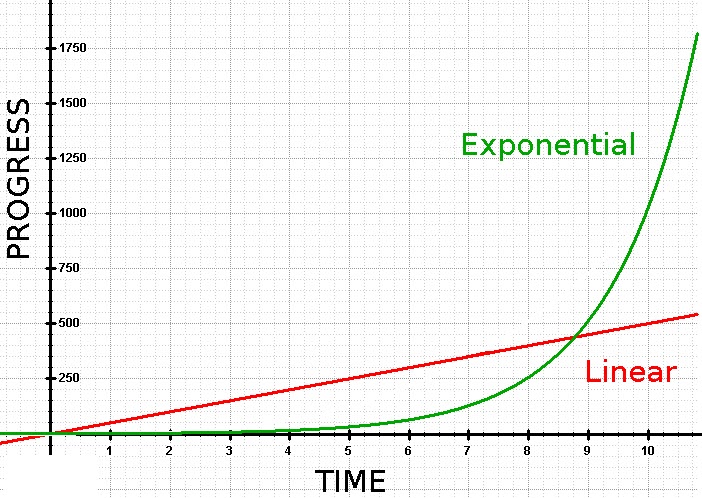
Anyway, Ray Kurzweil has been criticized for making the statement that all technologies are progressing at a exponential rate rather than a linear rate, which leads people to overestimate the progress in the short term and grossly underestimate progress in the long term.

Yet, there is room for criticism because not all technologies are moving at an exponential rate. The progress of curing different cancers, gas mileage for cars, and the comfort of computer chairs hasn't progressed as the speed for decoding the human genome has.


So the criticism is semi-warranted because Kurzweil does overstate his case a little bit, but does it really matter? I don't think so. If only one technology continues to improve at the exponential rate that it has historically been on than the criticism is really just window dressing distracting for the implications that are fun to think about. That technology is, of course, the computer.

So long as the progress of computers is exponential (which it is) the implications will be vast enough to make Kurzweil's predictions for the most part correct. Looking at what 'Watson' has done a couple of weeks ago in understanding human language and being able to answer questions it is impossible not to look into the future and think about the possibilities, some of which were mentioned in my last post.

As Yogi Berra it attributed to saying, 'It is hard to make predictions, especially about the future', but Kurzweil has a good track record and there is really no harm done in being wrong. The people who foresaw the flying car never broke into your house and peed on your rug.

Apart from the flying car, one prediction seems to stand out from the rest, when will humans build something that can be described as having a self? When will something be built and said to be conscious? Well that's a tricky question to answer, for a number of different reasons.


The standard test for telling if an animal has the concept of self is the mirror test, which involves putting an animal in front of a mirror with a dot on their body that they could only view in the mirror. The great apes, dolphins, orcas, elephants and a couple species of birds have all passed the mirror test. To pass the test the dot has to be noticed in the mirror and connected to the body of the thing in front of the mirror, this shows that there is an understanding that, that someone in the mirror is 'me' and they are curious why there is a dot on my back. For control there is also a dot placed in an area of the animal that is out of site when the thing is looking in the mirror, so that it can limit coincidental actions.

This test has be used to show that babies up to 18 months, dogs and cats don't react to the dot in any way and therefore lack the concept of the self, which can be noticed by anyone who has seen very young or handicapped children play 'with the boy/girl in the mirror.'

Well this test wouldn't work at all for computers, because they could be specifically made to pass the mirror test and respond to a dot put on them. It really breaks our standards to think about how to test for consciousness in a machine, which is why people look to the Turing Test as the Mirror test for computers. The test involves being having two chat boxes one being another human and one being a computer program and a person talking to both. The person  then has to decide which one is a program and which is a computer, when the two are indistinguishable the computer has passed the test.

But not all people feel that the Turing Test demonstrates much, a few philosophers like John Searle have go so far to say that the Turing test proves nothing about consciousness, or in effect that a talking tree could never be seen as conscious (I don't remember the name of who argued that). I'm not in their line of thinking, but I do feel that some part of the self involves having goals and motivations and a chat program while a program can say it has those things, it lacks the ability to act them out. This is not to say that something that passes the Turing Test isn't conscious, just that I'm not sure that I would be ready to call it conscious yet.

Another problem is that the Turing test isn't looking for consciousness, it's looking for human consciousness, its by definition looking for something that makes human errors and talks like another person would. It's telling when Kurzweil says that the computer will have to dumb itself down to pass the test, because it's not an ideal test of consciousness, and there lies the rub; Nothing is. If the program was elegant enough to throw in a few spelling mistakes, vulgarities and misconceptions it could probably make someone think it was yours truly, but it would have used parlor tricks to do so. 

The mirror test doesn't work for programs and the Turing test only works to find something compatible with human understandings, and could be prone to programs taking advantage by making mistakes that people wouldn't think that "computers" would make.

In fact, the whole topic might be a moot point. People subjectively deciding what is and isn't conscious seems like a huge pill of worms. If this surly scientifically done poll done on Just Labradors Forum, with the appropriate measures to account for bias, is correct than 78% of people believe that dogs are self-aware, 21% are undecided and 0% think that they definitely not self aware.  People are biased into thinking that biological things have consciousness and that machines don't, and the first conscious machines will be abused due to that fact.

When a machine passes the Turing Test and shows reasonable signs that it is conscious, it would be ethical to just treat it as such seeing how the criteria is so poorly defined and no test seems ideal.


Thanks for reading,
-themoralskeptic   


February 16, 2011

And Along Came Watson


I, like a lot of other people, have been a very interested bystander in Jeopardy this week and for good reason. For those of you who haven't been watching, an AI named Watson has been playing agianst the two most successful Jeopardy contestants to ever compete on the game. 

The name 'Watson' refers to, "A cluster of ninety IBM Power 750 servers (plus additional I/O, network and cluster controller nodes in 10 racks) with a total of 2880 POWER7 processor cores and 16 Terabytes of RAM." and has already been the subject of a Nova documentary entitled Smartest Machine on Earth.

The documentary did a great job at highlighting the problems that the questions on Jeopardy pose to a computer, it really should be mandatory viewing for people with no background on the subject to gain an understanding of the significance of what is going on. They are not simply just asking a question, the question is disguised in riddles, puns, slang, and elements of humor. To be able to solve these questions Watson has to have a grasp of human language and also form an understanding of the importance of different terms. 

So how did Watson do? So well that I didn't have to wait until the final episode aired to write this post. Watson was tied for the lead at 5000 with Brad Rutter after the first round, but the next episode when double jeopardy took place was a different story. Watson answered nearly every question correctly, including both daily doubles  and ended the game with $35,734 compared to Jennings's 4,800 and Rutter's 10,400.  

Watson was an overwhelming success and his/her/it's/whatever you want to refer to Watson as, margin of victory was so great that it almost totally rules out it being a fluke. A computer is now the best Jeopardy contestant to ever play the game.

Now the question comes up to how the task of playing Jeopardy compares to that of a Turing Test, which is something a little different but more challenging. Watson has been designed to be as smart as possible and to pick out the right answer to any trivia question someone can think of, even if that question is shrouded in humor, or the other things previously mentioned. It would work well in a hospital diagnosing illnesses, and tasks that require sifting through a vast amount of information for a specific answer and who wouldn't want a Watson on there phone to answer a nagging question. The Turing test would be a lot different though a computer would not only have the common knowledge that people have, but be able to relate to peoples emotions on a personal level, to understand humor as more than language, and to even make human errors. 

Watching Jeopardy and writing about it brought up the question of 'What does Ray Kurzweil think about Watson and especially it's implications to the Turing Test?' Luckily for me and anyone who had their mind wandering in the same direction Ray has already written an article entitled the, "The Significance of Watson'. He actually wrote it before the episodes aired, because he knew that even if Watson didn't win and even looked bad, that it would only be a matter of time before they would be better than their human opponents. 

I'll summarize and pick out the most important things from the article he wrote. 

First he explains one aspect of human intelligence,

"Indeed no human can do what a search engine does, but computers have still not shown an ability to deal with the subtlety and complexity of language. Humans, on the other hand, have been unique in our ability to think in a hierarchical fashion, to understand the elaborate nested structures in language, to put symbols together to form an idea, and then to use a symbol for that idea in yet another such structure. This is what sets humans apart.That is, until now."


Then he makes an estimate on how long it will take for each of us to have a Watson at home.

"Computer price-performance is now doubling in less than a year, so 90 servers would become the equivalent of one in about seven years. Since a server is more expensive than a typical personal computer, we could consider the gap to be about ten years."

Then Ray gets to whats really important to him, the future of computers and a computer  taking the Turing Test.

"Mitch Kapor and I bet $20,000 ($10,000 each), with the proceeds to go to the charity of the winner’s choice, whether a computer would pass a Turing test by 2029. I said yes and he said no."

and

"What does this achievement with “Jeopardy!” tell us about the prospect of computers passing the Turing test? It certainly demonstrates the rapid progress being made on human language understanding. There are many other examples, such as CMU’s Read the Web project, which has created NELL (Never Ending Language Learner), which is currently reading documents on the Web and accurately understanding most of them."

Well I'd say, he is well on his way to winning some money for the charity of his choice because Watson is well ahead of what I expected for language recognition and would only need to expand his programing to understand more formally uniquely human things.

What is funny though is that for a computer to be human Ray realizes that it will have to dumb down what it knows, 

"It is important to note that an important part of the engineering of a system that will pass a proper Turing test is that it will need to dumb itself down. In a movie I wrote and co-directed, The Singularity is Near, A True Story about the Future, an AI named Ramona needs to pass a Turing test, and indeed she has this very realization. After all, if you were talking to someone over instant messaging and they seemed to know every detail of everything, you’d realize it was an AI."

He also knows what will happen after Watson performance is commented on, the significance of Jeopardy will be lessened and it will be looked at as a fact finding game, something computers should be good at, and emotions and humor are where humanness lies, but the door are being knocked on and human uniqueness is shrinking.  

"What will be the significance of a computer passing the Turing test?  If it is really a properly designed test it would mean that this AI is truly operating at human levels. And I for one would then regard it as human. I’m expecting this to happen within two decades, but I also expect that when it does, observers will continue to find things wrong with it."

Well we may not have to wait too long to find out, just ask Watson.
Thanks for reading,
-themoralskeptic