Showing posts with label Ethics. Show all posts

November 23, 2017

Sam Harris, Meditation, Mental Illness and a Question from British Columbia

Picture from ABC News 

I'm going to preface this post by saying that I like and respect Sam Harris. I think he is one of the preeminent popular intellectuals that is currently active and I am in agreement with him on the majority of issues which he speaks about. I think his takes on identity politics, free speech, religion, and many other topics are largely correct.

In addition to that, one thing I really appreciate about Sam is how thoughtful he is. That thoughtfulness can be heard in his podcast in the respect he has for his guests, in how he wants his guests treated by his audience after they are on the podcast and in what he wants the experience of being on his podcast to be like (https://www.samharris.org/podcast/item/the-limits-of-persuasion) about 28 minutes in.

In addition to that, he shows his thoughtfulness in his approach for donations to his podcasts where he asks for donations, but limits his request to those who can easily afford it. This may seem trivial, as someone who doesn't have the money to donate, probably wouldn't donate anyway, but it shows how he is expressing a feeling for his listeners that often isn't expressed. I respect him making that statement and the thought that went into making it.

Yet, I do have an issue with something Sam said in response to a question asked at The Orpheum Theater in Vancouver that was recorded in his most recent podcast. I think in answering the question he missed the thoughtfulness that he usually gets right.

Question: "Hi my name is Randy. My question is for Sam. I wanted to know what role meditation has played in your mental health, I guess. Have you been more resilient to depression or anxiety? Because it seems like your always kinda being attacked by somebody either Batman or having Charles Murray on your Podcast. Because I'm at a point where I'm kinda done with antidepressants, psychotics and mood stabilizers. I want to try something new, so what's your take on meditation as a mental health treatment?"

Answer: "Well, I think it can be incredibly useful. I think there are certain people who probably shouldn't go on intense silent meditation retreats so I wouldn't recommend the most intense meditation experiences for everybody. There are people who find going into silence for a week or a month destabilizing and that's a tiny percentage of people but you should be aware that it is possible to have a bad experiences doing a lot of meditation. 

The kind of meditation I recommend is just learning to pay much more careful attention to what it is like to be you. When you pay attention, you begin to notice all the ways in which you are suffering unnecessarily. The universe didn't have to be this way, but is just so happens there is a direct connection between seeing more of what is actually happening in your own mind and ceasing to suffer in many of ways that are unnecessary. Honestly, it is the most important thing I've ever learned, but it's not necessary to learn most other things, it's orthogonal to almost everything else we care about intellectually. It's not that I don't suffer in all the ordinary ways that I suffered with before I learned to meditate. The half-life of suffering, the half-life of something like anger or anxiety or embarrassment or fear or whatever the negative mindstate is, it's cut way way down and also behavioral consequences of those negative emotions, the door is closed to those. 

When you think of the difference between being angry 10 seconds and then actually letting it go and being angry for an hour, right, it's an enormous difference, because in that hour you can get up to doing all kinds of life deranging things on the basis of anger and feel good about doing those things, right, because you damn well should be doing those things because you're pissed. Just shorting the time of all these negative states is [an] enormous benefit. Meditation is a great tool for that."

I didn't want to judge Sam's response and write this without looking into the efficacy of meditation as a treatment for depression and there is some pretty solid evidence [1, 2] that meditation may be as effective a treatment as antidepressants for depression, but this is to be taken with some precaution. The general results from different studies tend to point to mindfulness being more successful at dealing with stress than anxiety or depression, which each have smaller effect sizes. There does seem to be an effect for meditation in the treatment of mental illness, what I presume Randy was suffering from, with meditation.

However, there are two larger problems pointed out by Steven Novella.

1.The problem with this research is that it is largely preliminary, as the specifics that makeup mindfulness is not always consistent, and there remain questions about what type of people benefit the most and with what severity of condition mindfulness is most effective at treating. This is fine as the results seem to be trending in the right direction of it being an effective treatment, but there are issues that remain to be settled.

2. The control measures used as opposite of mindfulness are not adequate. Mindfulness is tested against medication and placebo medication, but not against relaxation or sham mindfulness. This is problematic, as it makes it unclear if there is something specific about mindfulness that is helpful or if it is a product of relaxation which isn't specific to mindfulness.

That being the case and my expectation that Sam, who is likely more educated on the subject than I, should have had a more thoughtful response to that question. I am fine with him talking about his experience and how it has affected his life, but I think that his response lost track of the context of the question being that, the person asking the question is someone with serious problems talking about ceasing to take all their medication. Somewhere in that response there needed to be a caveat about talking to a doctor about his decision or getting some kind of medical advice before just stopping his medication.

Sam's response, unfortunately, reminded me of the type of response that is characteristic of proponents of alternative medicine, 'Here is my personal experience of it working and it was good for me.' In that, I expect a higher quality response for Sam Harris and maybe he simply lost track of that part of the question, but I was disappointed that it wasn't there from someone who usually gets those parts correct. Further, he didn't mention the evidence in support of meditation being used to help treat mental illness which is also disappointing, but that bothered me less than not addressing the context of a person threating to stop taking all their medication.

Given that there is some medical evidence for meditation being helpful am I over-reaching in my criticism of Sam's response? Does he, as a proponent of meditation, have an ethical responsibility when someone is asking a question like that?


July 17, 2012

Groundhog's Day - Phil Connors is a Pitiable Killer


   Groundhog's Day is one of my favorite films and I can't really put a finger on why exactly that is, but I can think of many reasons why I like the movie so much. I don't think I need to announce that this post will contain many spoilers for the movie, but I just did anyway. This post also ran a little longer than I like to aim for in a blog post so it will be broken into two riveting parts, and I can only hope that excitement can be contained until the second installment is posted.
 
     Anyway, I first saw Groundhog's Day before I knew what philosophy was and just appreciated how funny, yet the odd tale was, but later I realized how interpretable this film is. There is a lot to think about in this film and I'm only going to write about what I thought about on one a sleepless night not so long ago, but before that, I'll give a brief summary for those unfortunate philistine's who haven't seen the film.

   The movie starts with Bill Murray playing the main character, Phil Connors. He one of the great miserable asshole's Bill Murray has played in his career and also a TV weatherman for a medium-sized TV network doing a segment in a small town for, you guessed it, Groundhog's Day. He ends up getting stuck in a town he hates because of snow and wakes up the next morning to find out that it is Groundhog's Day morning again. The same things that happened to him yesterday are happening again today; He is stuck in a loop which doesn't seem to have an end.
    
     Phil Connors then goes through a progression of different goals for the day. He just lives it up having fun and gorging himself with food and women, and then gets hopeless and tries to kill himself.After that he tries to find meaning by saving an old homeless mans life, but alas, but as Bill Murray's character repeats each day, this meaning also dies each time at around midnight.
 
    After numerous attempts at all sorts of things, the right answer is found when Phil stops being the miserable asshole and starts being a genuinely kind and good person. This is the secret and after a day of being a good person he gets the girl, they live happily ever after and it's a good ending...or is it?

    When Phil Connors travels to the next day at the end of the movie it is celebrated with cheers of triumph. Yet, when Phil is kissing the hotel manager out of happiness, one person isn't enjoying the festivities, as when the loop ends the homeless person Phil was staying to save is no longer reborn. In traveling to the next day Bill Murray's character has ironically found the only way to really kill the man he earlier was so desperately trying to save. If he had not closed the loop the man would have continued to be reborn and lived his life forever. Morally Phil Connors might have been in a position to try to stay in Groundhog's Day forever if he knew the consequences of his actions.

   There is another interesting consequence of the loop being closed at the end of the movie. It could be taken further and argued that Phil Connors shouldn't have been celebrating the end of Groundhog's day, and instead been mourning its demise.

   Albert Camus would view the situation that way as he explains in The Myth of Sisyphus. In Camus's  view what matters most is not the type of life lived, but the amount, as the continued struggle against the absurd is what matters. People would argue, as Bill Murray's character surely would, that if Phil Connors doesn't travel to the next day of his life than his life is meaningless because there is no progress or time. The major question than is, is there a meaning of life?

    42 jokes aside, there isn't an external meaning of life that can be found and pointed to and Camus realizes this, making life a battle of living without meaning, or in short an absurd existence. In this battle for meaning the absurd is where one can find enjoyment, even if you are only rolling a rock to the top of a hill for eternity. In fact being able to continue that fight for eternity makes you not someone to be pitied, but someone to be envied. Phil Connors didn't have a rock to push, but he did have the potential to fight against the absurd and reflect on life for an eternity thus making him a hero. Instead through celebrating the ending and closing of the loop he is no longer the Sisyphusian hero, and instead a nice guy and a killer.

Thanks for reading,
-the moral skeptic  

May 11, 2012

Kingston Police Doubles Down on Power Balance


The amount of disappointment I have towards the decisions of the Kingston Polices choice to promote Power Balance is hard to match, but the overwhelming condemnation of their choice should inspire a lot of hope that at least next time they will do a background check into products they put on their website and spend uniformed time selling. 

Kingston Polices twitter responses to Matt Watson shows why there isn't much hope for optimism yet though. Here is a copy of the twitter conversation between the two:

Matt Watson: you're selling those bracelets knowing full well they're advertising false benefits. Shame!

Kingston Police: Oh my, we've already addressed this. Don't endorse any purported effects. Most buy b/c they simply like the look, goes to good cause

Matt Watson: pardon the pun but what a cop-out. Selling them at all is endorsement and contributes to the perception they're effective.

Kingston Police: Pun pardoned. Raised $1,000s for , only you & 1 other has complained in 6 months, selling candy bars worse effect.

Matt Watson: that just goes to show people perceive them as legitimate and don't question the pseduo-science.

Kingston Police: Thanks Matt. No one is forcing you or anyone else to buy them. You're welcome to simply donate $10 to the Special Olympics instead.

Thanks to Matt for arguing pretty well in the 140 character space. The logic and ethics lying behind whoever is representing Kingston Police is completely perverse, they are doubling down with their chips on stupid. Advertising and providing legitimacy for a product that is actively deceiving its buyers was bad enough, but it is only worsened by the horrible logic used to defend their choice. 

There are 3 things that stick out from what was tweeted.

1. By putting a disclaimer Kingston Police can excuse itself as endorsing Power Balance:

This is a complete joke, first of all they advertise effects on their website which includes the statement that the benefits of negative ions (The 'good ions' that are in the Power Balance Band) are  higher levels of focus and concentration, increased feeling of serenity and well being, improved strength, flexibility and balance, elevated relaxation of body and mind, restful sleep, lessened recovery times and an injury or workouts, improved athletic performance, and relief from chronic joint and muscle pain. 

Which is a false list of effects of negative ions and not Power Balance, so even if Kingston Police doesn't support the product it is unclear if they think that the effect of negative ions are as listed above.

Just having to write that list makes me want to look for some chronic joint relief. At least in that state of mind maybe I could begin to understand how listing the benefits of a product on a police webpage and having uniformed officers selling Power Balance bracelets doesn't equate to an endorsement. 

2. It's better than selling candy bars:

Well I'd disagree that supporting a product that actively deceives the buyer is better than selling a product that isn't healthy, the whole thing is a false choice. The choice wasn't between a candy bar or power balance, as Kingston Police points out in their last tweet that says they could, and can still, take donations without the bracelet. 

Personally I wish they had sold Placebo Bands, which have the same hologram that impressed the Police and comes 100% Bullshit free and are a non-profit product.

3. If nobody complains it's alright:

Only you and one other has complained in 6 months.....so what? I guess if a tree murders someone in the forest it doesn't make a sound. Unfortunately, right and wrong doesn't rely on complaints, and whoever is representing the Police surely acts this way in most situations, but from some reason has compartmentalized this instance. 

It's disappointing when you point something out that is clearly wrong and the person just sticks with what they believed before, a phenomena that Chris Mooney does a great job at pointing out in his Point of Inquiry interview. 

I do remain hopeful that given increased attention and complaints that the Kingston Police will stop advertising Power Bands on their website and stop selling it in uniform.

Feel free to email Chris Mcfie cmcfie@kpf.ca and point it the hypocrisy if you see it in person, although that may be for the brave, as uniformed officers don't have a history of responding well to criticism, no matter how well founded.

Thanks for reading,
-the moral skeptic

May 10, 2012

Kingston Police Selling Power Balance Wristbands


I was aghast at Cost-Co on the weekend, and it had nothing to do with low prices or 50 lbs. bags of dog food. As I was entering the store I saw a strange union set up at a table beside where the cards were flashed to gain entrance. I blinked and took a second look, but, unfortunately, it only made the picture more clear. The Kingston police were selling Power Balance wristbands.

I looked around for the same disbelief that must have sat registered on my face smeared on anyone else, but I didn't see it. I could forgive the lack of awareness for the people around me, but from the police, I could only find contempt for their negligence and stupidity.

The police are people who investigate things and are trusted to make good decisions, but any quick search will show that this was a boondoggle from the start. Power Balance wristbands are a rubber bracelet with a hologram inside it, that is claimed to improve strength, athleticism, and balance, by working with the body's natural energy fields and frequency. The only problem is that it's a known and proven scam.

The Journal of Bodywork and Movement Therapies studied them and found that "Results indicated that there was no statistically significant mean change in balance performance brought about by either the placebo or the Device." The BBC tested them and the headline of the story explains the conclusion, "Power Balance band is placebo, say experts" and Committee for Skeptical Inquiry took former Olympian Dominique Dawes and 14 other people test them and found that Power Balance bracelets are "A bust".  Look up any independent test of them and see the conclusions.

In fact why even look for independent tests, here is the word from Power Balance themselves, "We admit that there is no credible scientific evidence that supports our claims and therefore we engaged in misleading conduct in breach of s52 of the Trade Practices Act 1974." which they published in Australia after losing a battle with the trade commission there. Power Balance has also been fined in Italy and the Netherlands for making unverifiable claims. 

All the evidence points to the bracelets being a scam, and also shows that Power Balance is run by a company who actively deceives the public. Why on Earth would the Kingston police support this and even advertise for it on their own website?  They give the disclaimer that,  "Kingston Police dose not guarantee or endorse the effects and benefits claimed from this product." only after listing a clear message that Power Balance would only dream of.

The only redeeming quality is that some of the money goes to help the Special Olympics, which I can tell you as a former Personal Support worker for people with special needs is a great cause. I encourage donations to the Special Olympics, but am dismayed at the Kingston Polices ignorance, negligence, and lack of investigation into a proven swindle. The police are supposed to be protecting the public from things like this, not actively taking part in it.  

In Australia the Australian Competition and Consumer Commission (ACCC) has ordered Power Balance Australia to refund all customers who feel they were misled by the supposed benefits of Power Balance bracelets and in Canada we have the Police raising money with it....

Thanks for reading,
-the moral skeptic

June 29, 2011

Taking Something Away vs. Not Doing Something


I while ago I read Sam Harris's book, The Moral Landscape, which I have referenced a couple times in previous posts. Harris, at one point, talks about how taking away something is viewed as worse then not doing something, and gives an example using two people.

The first person is a girl who has an 160 IQ and great musical ability, this person isn't given the correct treatment and because of that her IQ drops to 100 and she looses her musical ability. This is contrasted with a girl who has an IQ of 100 and with a pill given at the right time would have her IQ go up to 160 and gain a great musical talent, but the pill isn't given so she remains the same.

Now the end result is the equal and each girl has lost something, but people view the first girl as suffering much more than the second. It is from answering questions like these that it is learned that an act of taking something away from someone is viewed as much worse then not doing something to help someone.

This I don't really have a problem with, because it is worse to lose something then never get something, because there is a greater appreciation of what was actually lost, the old adage, "You don't know what you have till it's gone."

I do have a problem when this line of thinking is combined with the belief that anything natural good, or is at least acceptable, and this recently came up in a conversation. Somehow the topic came of reincarnation came up and a older woman said that, "If it's true than you should be good or you'd come back as something like a worm."

Now I don't believe in reincarnation, but I wouldn't usually have had a problem with other people believing in it, or someone talking about it, but that statement I do and did take offense too. There are people with the belief that if you have done something bad in a previous life that you are punished in the next life for it, so nothing should be done for people who face a 'natural' problem and thus they should be left in a state of suffering, which is horrible. 

So I interrupted the person and stated exactly what I summarized in  the paragraph above, when another lady, who happened to be very well educated, disagreed with what I said and talked about how living with a problem could be a learning experience and lead to enlightened/diverse perspectives.


Only someone educated could come up with such stupid reasoning to accept the suffering of others, and actually come up with a justification for finding nothing wrong in doing nothing at all for someone in pain.

It's as if because something is natural then it can be said to be alright, so if someone goes blind it might lead natural path, but if I stabbed someone in the eyes then it's a bad thing. The scale has tipped too far in the direction of taking something away being bad and not doing something being thought of as alright.

Not doing something is bad, should someone have to live with ALS, MS, or Cancer because living with them might lead to a different life view, or should people born deaf not have the hearing restored because some deaf people don't see it as a disability.

Ask anyone with hearing if they would go back and make it so they couldn't hear when they young, and it'll be easy to see the ethics in changing somethings natural course. Not doing something may not weight equally with taking something away, but it still has weight.


Thanks for reading,
-the moral skeptic

May 11, 2011

3 Stories from Nature: Don't look to Nature for Morality


Well, I think that my last post was the most widely read post that I've written to date, so to capitalize on that momentum I've waited a few weeks and made sure the previous interest has waned.  Now it is often said that humanity shows a truly unique notion of cruelty and evil; this is true. There is no animal equivalent to holocaust or genocide, and animals aren't able to possess  the 'guilty mind' that makes up part of a crime, yet the roots, even of such 'unnatural' behavior, can be been from the acts of different animals.

At this point a brief disclaimer is necessary, because despite what I just said in the previous sentence some people may accuse me of anthropomorphism. I am of the opinion that American Law got it right when they expressed that an animal cannot be charged with a crime, for the reason I stated above. The quick brown fox that jumps over the lazy dog to kill a mouse isn't doing so out of malice.

This leads many people to say that animals kill only out of necessity, and don't show anything that would be described at immoral behavior. These beliefs are like that of the noble savage that lives at one with nature and other people, they exist only in a romantic dream, not in reality. Nature is not where morality can be found like a rare fruit in the upper branches of a tree, it is where the roots of both moral and immoral acts can be seen.

Story 1 - The Necrophiliac Mallard

Natural law proclaims that things have a purpose and should only be used for that expressed purpose. This is the foundation for calling homosexual acts 'unnatural'. Now it has been shown that this unnatural act happens in many different types of animals, making humans no special case, but that's not really interesting and doesn't really have the feeling that comes with an act that is considered immoral behavior.  However, there is one case that I know of that does.

In 2001, the first case was described of homosexual necrophilia in Mallard Ducks. In June of 1995, there was a loud bang. The sound was that of a duck crashing into a window, but when C.W. Moeliker went to see what it was he saw two ducks not one. Next to the dead duck that had just crashed into the window was a male duck and from the title of this first story there will be no prizes for guessing what happened next.

"He forcibly picked into the back, the base of the bill and mostly into the back of the head of the dead mallard for about two minutes, then mounted the corpse and started to copulate, with great force, almost continuously picking the side of the head."

C.W. then watch as the rape continued for 75 minutes, with two short breaks. It was only broken up when C.W. approached to within 5 meters of the ducks and even then the other male didn't fly away, but walked a few meters away.


This may sound like a unheard of event, but 2-19% of ducks are in homosexual couples and there have been descriptions of heterosexual necrophilia in ducks, so while it may seem too strange to be true, it's really just a matter of probability that the two actions be observed together eventually.

That said, clearly even depraved sexual actions take place in nature and animals don't live in the the heterosexual harmony that most assume. The birds might wait until the bees get stunned and fly over to mate with them in their death....bringing a whole different meaning to the birds and the bees.  

Story 2 - A Killer on the Loose

In the Essay, "The Horn of Triton" Stephen J. Gould reflects on the power of different individuals to change the history of a local population by way of two rather chilling stories from the animal kingdom.

The first killers were two Chimpanzees from Jane Goodall's studies named Passion and her Daughter Pom.  In 1975 Passion began to kill and eat newborn babies of the other females in her band, but she could not easily steal the babies from their mothers watch, but Passion didn't have to work alone. Pom would work with Passion to steal, kill (biting the infants through the skull), and eat the infants of other community members.

This immoral act was seen by observes three times, and may have happened an additional 7 times, as over a four year period only one mother was able to keep her offspring safe.

This again isn't an isolated event, our closest animal relatives may be more inclined to kill that Gould and Goodall first though as new descriptions of this type of occurrence have been detailed since then.  Live Science has an article that describes infanticidal attacks by female chumpanzee's.  It describes an event where,

"Alerted to the killings by sounds of chimpanzee screams, last year Townsend and his colleagues directly witnessed one infanticide, where a bleeding mother with a one-week-old child in tow was pursued by six females, five of which had clinging infants themselves. After a 10-minute struggle, the infant was taken and killed with a bite."

They also found evidence for two more killings of this type as dead chimpanzee infants were found with bite marks in the skull.

These killings don't happen out of necessity, or defense, they are murders on community members and while done without the knowledge of being a crime are enough to show that the term murder wouldn't be completely out of context within nature.


Story 3 - Dog Days of Summer

The second story from "The Horn of Triton" essay by Stephen J. Gould takes place in New Zealand where Micheal Taborsky was studying brown kiwi's. The kiwi's had a population of 800-1000 members and Micheal had managed to tag 24 birds with radio transmitters.

August the 24, a dead female kiwi with a radio transmitter was found dead, and by September 27, over half of the tagged birds had been killed. The birds were mostly found burred and missing feathers in different areas. 10 other birds without transmitters were found the say way, running the death toll up to 23.

The culprit of this culling was not a new migrant species or even a group of animals. It was a single German shepherd. Distinctive footprints were found along with dog droppings of a single type and size, and on September 30th that single female German shepherd was shot and the killings abruptly stopped.

Now 23 birds may not seem like a big deal, but the sample is skewed, for there is no reason to think that the birds with transmitters were special. The percentage of there deaths probably provide a more accurate understanding of the true scope of the killing performed by that single dog.  The actual total wouldn't be 23, and Taborsky estimates the real number to be 500-800 of the birds who had a total population of 1000.

He gives 3 reasons for this seemingly high estimate, "First, given the remote chance of finding a buried, untagged carcass, the ten actually located during the interval of killing must represent the tiny pinnacle of a large iceberg. Second, other evidence supports a dramatic fall in total population: Taborsky and colleagues noted a major drop in calling rates for these ordinarily noisy birds; a dog trained to find, but not to kill, kiwis could not locate a single live individual (although she found two carcasses) in a formally well-inhabited section of the forest. Third, kiwis, having evolved without natural enemies and possessing no means of escape, could not be easier prey."

This leaves Gould to conclude that the romantic notion that animals kill only for food or defense is a complete misconception and this German Shepard was following the killing pattern of many animals.

These three stories from nature have shown the roots of behavior in indiscriminate killing of other species, perverse sexual acts, and even within the group group murder. Man and woman are only special in the regard of truly being able to appreciate the consequences of their actions. We are not special in being unique in committing the acts themselves, as they are only natural.

Nature isn't a place of ideals and morality, it is a reflection of the causes that created us as killers, rapists, and altruistic cooperators. Nature may be able give us a framework to tell us why we are who we are, but it can't tell us how we should act in the future or who we should be; Nature is no ethical guide.

Thanks for reading, 

-themoralskeptic

March 2, 2011

Judging Computer Autonomy


Well I can say that I was satisfied with the content of my last post, but I did let a couple of issues slide past that I would have liked to address. I really let Ray have his way due to the time constraint of having to go to work. Damn work requiring its workers to be there at certain times and damn money needed to be gambled away.

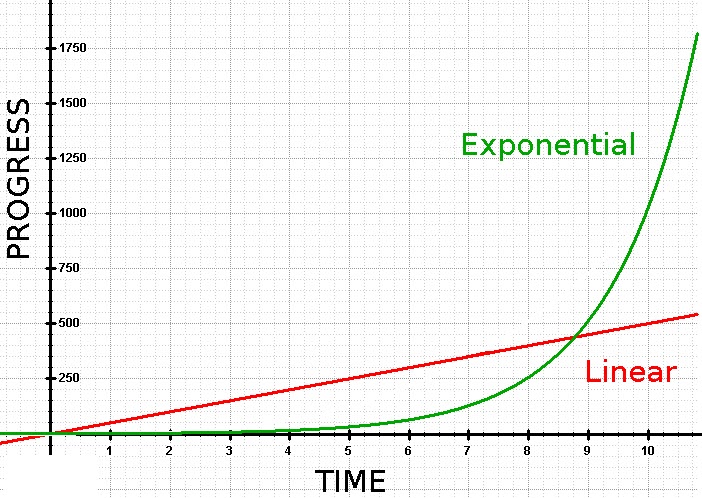
Anyway, Ray Kurzweil has been criticized for making the statement that all technologies are progressing at a exponential rate rather than a linear rate, which leads people to overestimate the progress in the short term and grossly underestimate progress in the long term.

Yet, there is room for criticism because not all technologies are moving at an exponential rate. The progress of curing different cancers, gas mileage for cars, and the comfort of computer chairs hasn't progressed as the speed for decoding the human genome has.


So the criticism is semi-warranted because Kurzweil does overstate his case a little bit, but does it really matter? I don't think so. If only one technology continues to improve at the exponential rate that it has historically been on than the criticism is really just window dressing distracting for the implications that are fun to think about. That technology is, of course, the computer.

So long as the progress of computers is exponential (which it is) the implications will be vast enough to make Kurzweil's predictions for the most part correct. Looking at what 'Watson' has done a couple of weeks ago in understanding human language and being able to answer questions it is impossible not to look into the future and think about the possibilities, some of which were mentioned in my last post.

As Yogi Berra it attributed to saying, 'It is hard to make predictions, especially about the future', but Kurzweil has a good track record and there is really no harm done in being wrong. The people who foresaw the flying car never broke into your house and peed on your rug.

Apart from the flying car, one prediction seems to stand out from the rest, when will humans build something that can be described as having a self? When will something be built and said to be conscious? Well that's a tricky question to answer, for a number of different reasons.


The standard test for telling if an animal has the concept of self is the mirror test, which involves putting an animal in front of a mirror with a dot on their body that they could only view in the mirror. The great apes, dolphins, orcas, elephants and a couple species of birds have all passed the mirror test. To pass the test the dot has to be noticed in the mirror and connected to the body of the thing in front of the mirror, this shows that there is an understanding that, that someone in the mirror is 'me' and they are curious why there is a dot on my back. For control there is also a dot placed in an area of the animal that is out of site when the thing is looking in the mirror, so that it can limit coincidental actions.

This test has be used to show that babies up to 18 months, dogs and cats don't react to the dot in any way and therefore lack the concept of the self, which can be noticed by anyone who has seen very young or handicapped children play 'with the boy/girl in the mirror.'

Well this test wouldn't work at all for computers, because they could be specifically made to pass the mirror test and respond to a dot put on them. It really breaks our standards to think about how to test for consciousness in a machine, which is why people look to the Turing Test as the Mirror test for computers. The test involves being having two chat boxes one being another human and one being a computer program and a person talking to both. The person  then has to decide which one is a program and which is a computer, when the two are indistinguishable the computer has passed the test.

But not all people feel that the Turing Test demonstrates much, a few philosophers like John Searle have go so far to say that the Turing test proves nothing about consciousness, or in effect that a talking tree could never be seen as conscious (I don't remember the name of who argued that). I'm not in their line of thinking, but I do feel that some part of the self involves having goals and motivations and a chat program while a program can say it has those things, it lacks the ability to act them out. This is not to say that something that passes the Turing Test isn't conscious, just that I'm not sure that I would be ready to call it conscious yet.

Another problem is that the Turing test isn't looking for consciousness, it's looking for human consciousness, its by definition looking for something that makes human errors and talks like another person would. It's telling when Kurzweil says that the computer will have to dumb itself down to pass the test, because it's not an ideal test of consciousness, and there lies the rub; Nothing is. If the program was elegant enough to throw in a few spelling mistakes, vulgarities and misconceptions it could probably make someone think it was yours truly, but it would have used parlor tricks to do so. 

The mirror test doesn't work for programs and the Turing test only works to find something compatible with human understandings, and could be prone to programs taking advantage by making mistakes that people wouldn't think that "computers" would make.

In fact, the whole topic might be a moot point. People subjectively deciding what is and isn't conscious seems like a huge pill of worms. If this surly scientifically done poll done on Just Labradors Forum, with the appropriate measures to account for bias, is correct than 78% of people believe that dogs are self-aware, 21% are undecided and 0% think that they definitely not self aware.  People are biased into thinking that biological things have consciousness and that machines don't, and the first conscious machines will be abused due to that fact.

When a machine passes the Turing Test and shows reasonable signs that it is conscious, it would be ethical to just treat it as such seeing how the criteria is so poorly defined and no test seems ideal.


Thanks for reading,
-themoralskeptic   


January 19, 2011

An Exploration of Speciesism Continued


In my last post I gave a brief overview of speciesism and showed how we are all speciesists. This post will pick up where the last one left off. People treat different species differently, which is fine to an extent, but it can also go too far in either direction. 

1. The first direction that goes to far is the life is equal approach.Taking a page out of difference feminism some might argue the principle of different but equal. Meaning different species deserve to be treated equally well, but that equality obviously doesn't mean they should be treated the same. Yet, this principle would be strong enough to put one animals death, be it coral or an amoeba on equivalent terms with any other animals death (cat, dog or human), and it is unclear to me if it would extend further to carrots or potatoes, but I don't see an reason why it wouldn't if the value is strictly something being living.

While this is a position that can be maintained, at a great cost, it doesn't seem either realistic or ideal. There is a qualitative difference between a chimpanzee and an amoeba, and between a human and any other species. While all life should be valued all life isn't equal and no one, despite their best effort, treats life as it is.  

For instance, take parasites. I don't know of one person who values their life equally to the lives of harmful parasites within their body. Ticks aren't invited and welcomed to peoples body, and neither are intestinal flukes, pin worms or tapeworms. Once infected with such creatures their right to life doesn't ever come up, nor should it, but it would if people really wanted to be non-speciesists.

There also wouldn't be any wind power if the lives of birds and  bats were weighed equivalently with that of humans, as thousands and thousands of birds and bats are killed each year by the silent green killer. The American Bird Conservancy notes that, 


"Recent U.S. studies indicate that bird mortality at wind turbine projects varies from less than one bird/turbine/year to as high as 7.5 birds/per turbine/year. This means that between 10,000 and 40,000 birds may be killed each year at wind farms across the country - about 80% of which are songbirds, and 10% may be birds of prey. While not a large figure, local or regional impacts may be significant, and the rate of increase in turbine construction has conservationists concerned that new generators be built to standards that minimize the potential for bird kills. Bats are also subject to high mortality at wind farms frequently at considerably higher rates than birds."


Could you imagine if wind turbines caused that many human deaths? People would be up in arms, heck even if turbines caused that many deaths in cats or dogs people might take a different stance on wind power.

2. There is another direction that goes to far the other way and doesn't value animal lives, except in how they affect humans.

Immanuel Kant and his theory of ethics is one where animals have no moral value, except in how they can change human behavior, i.e. People shouldn't kick cats because it might get them into the habit of kicking young adults.

Penn and Tell in season 2 of Bullshit! also echo this type of moral reasoning when they say that they, "Would personally strangle every chimpanzee to save one street junkie with aids." I know what your all thinking, isn't there a less labor intensive way to do that, I mean wouldn't your hands get sore?

While the elimination of a species like that seems immoral it seems less so when a little logic is applied. Almost all people would agree that one human life is more valuable then the life of a Chimpanzee, so if they had to kill one Chimpanzee to save a human life, it would be bye bye Chimp. Yet, this question starts to really get interesting when a second chimp is added to the equation.

I don't think that the second Chimpanzee would effect anyone's choice of what to do, if you wouldn't do it in the first place then the second chimp wouldn't have an effect and a person willing to kill one chimp would pass a threshold where a second chimp wouldn't affect the choice very much. What the second chimp really does is create a slippery slope, where if you are willing to kill 2 chimps then why not 3, 30, or 300.

Like the Milgrim Shock Experiment when people are willing to go a certain distance, they end up going the rest of the way.

Yet, I don't think that many people would be willing to eliminate a species to save one human life and human actions support that belief. Lots of different types of animals kill people and no one is seriously trying to eradicate those human killing species from existence. While Penn and Teller would strangle every Chimpanzee, they should also be getting rid of every Lion, Bee, and even possibly peanut, as they kill many more than one junkie with aids a year.

There has to be a middle ground between the two beliefs that really accounts for both how people act and how people think about animals, but finding that ethical middle means wading through a ton of problems to which there is no clear answer.

The first problem that really stands out is something that has been expressed by both Jarred Diamond and Richard Dawkins previously. People value even perceived humanity over reasonable expectation of pain, or consciousness.

Dawkins express this by saying, "Such is the breathtaking speciesism of our Christian-inspired attitudes, that the abortion of a single human zygote (most of them are destined to be spontaneously aborted anyway) can arouse more moral solicitude and righteous indignation than the vivisection."

While Diamond says with less venom that, "...it's considered acceptable to exhibit caged apes in zoos, but it's not acceptable to do the same with humans. I wonder how the public will feel when the identifying label on the chimp cage in the zoo reads 'Homo troglogytes'"(page 29 of The Third Chimpanzee).

The perception of being human or even close to human is what seems to have ethical value, not the ability to feel pain or be conscious. As Sam Harris would say, there are many peaks and valleys in morality. The perception of humanness is a valley we have yet to fully climb, while other summits are still just being looked at.

Thanks for reading,
-the moral skeptic

September 14, 2010

Belief in God Compared to Ethical Beliefs


I'll have to apologize for this post taking longer than it should have as I was facing a number of problems. My internet has been his and miss, with more misses than hits over the past few days and I've been busy doing a few other things. Anyway, I'm sure this post will be enough to remedy those in need of a good skeptical healing.

Previously, I compared the belief in God to personal taste and concluded that the two beliefs weren't alike, but it got me to thinking that perhaps belief in God arises like a belief in what is ethical. I got this idea through contemplating David Hume's understanding of morality.

To give brief outline of Hume's Ethics I'll quote a few lines from A Treatise of Human Nature.

"For before reason can perceive this turpitude, the turpitude must exist; and consequently is independent of the decisions of our reason, and is their object more properly than their effect." Hume then uses this to show that if reason isn't a part of morality and it is something natural. Than it is present in the actions of animals and they should be held in account to the same moral standard as people. Hume does this through saying, "Their want of sufficient degree of reason may hinder them from perceiving the duties and obligations of morality, but can never hinder the duties from existing; since they must exist in order to their being perceiv'd."

Then comes Hume second part, which is more applicable to the notion of God. His idea is that morality doesn't exist in actions or acts, but in the viewers mind.

Hume states that, "Take any action allow'd to be vicious: Willful murder, for instance. Examine it in all lights, and see if you can find that matter of fact, or real existence, which you call vice. In which-ever way you take it, you find only certain passions, motives, volitions, and thoughts. There is no other matter of fact in the case. the vice entirely escapes you, as long as you consider the object. You can never find it, till you turn your reflexion into your own breast, and find a sentiment of disapprobation, which arises in you, towards the action."

No matter where you look for he moral part of an action, it can never be found, and it is only when  you look internally at yourself that morality begins to appear. 

"So that when you pronounce any action or character to be vicious, you mean nothing, but that from the constitution of your nature you have a feeling or sentiment of blame from the contemplation of it. Vice and virtue, therefore, may be compar'd to sounds, colours, heat and cold, which, according to modern philosophy, are not qualities in objects, but perceptions in the mind."

Morality then is a perception of the mind, which Hume will call a sentiment. 

"It maintains that morality is determined by sentiment. It defines virtue to be whatever mental actions or qualities fives to a spectator the pleasing sentiment of approbation; and vice the contrary."

This is more like how people understand God. They look at different complexities and come to an understanding that is based on sentiment and exists solely in the view of the spectator. So when a person looks at the sky, stars, or ocean and get a feeling that God did this, it is based on personal sentiment.

While this is all hearsay because I can't demonstrate that this is how people come to an understanding of how God works, it works functionally. Just as Hume showed with morals, God can't be found in any individual thing. A person instead needs to look inside themselves to finally understand where God is.

Take, for instance, someone who looks at the the ocean and sees God in it. In what part of the ocean are they seeing the god part? Where is god among the ocean is God? God is only found in the minds perception of the ocean. 

So while God didn't create and cannot be found in the ocean, the mind of the person can still none-the-less attribute it's occurrence as proof of God's handiwork. This in no way proves that God created the ocean. It is as much proof as someone having the perception that homosexuality is wrong proves that homosexuality is actually wrong. It is a completely circular understanding. It is so far removed from proof or even evidence that it doesn't even impact how plausible God is.

This analogy works in another way as well, it shows the black and white nature of both decisions. When someone finds an action to be moral or immoral in their mind, there is no room for any gray area; An action is either viewed as immoral or moral. This is the same with the view of God. No one expresses the view that there is a 50% chance that god is responsible for the creation of the earth. There is a great confidence in the answer when it is given.

So there you have it, the best analogy for the belief in God is comparing it to Hume's description of Ethics.

Thanks for reading,
-the moral skeptic

May 13, 2010

Interview Questions and Lying in an Job Interview

I've wanted to write on this topic for a while and this post has been a topic that has been mulling around in my mind. The topic initially came to mind when I talked to two friends who were job hunting and in their search applied to Future Shop, the electronic retail giant. To start their application to work there they had to answer some questions on a computer program to determine their suitability for working at Future Shop. Now I'm not aware of the nature of the questions outside the one question they told me about, but the one they talked to me about was very interesting.

The question was a simple one, with what I think is a straightforward answer, 'Have you ever stolen something from a place where you worked?' The answer in the context of a person looking for a job, and being asked that is of course, 'No I've never stolen anything at all, let alone from a place I've worked' or something to that effect. That answer was given by one of my friends, but the other had a much different take on the question. He, being naive, thought that it would be unrealistic to never have taken anything from work before, so he stated that yes he had taken something from a former workplace, a few pens to be exact.

Needless to say that the person who said that he had never stolen anything before was given another few questions to answer and my other friend who said he stole pens (I'm pretty sure he's never stolen anything in his life) was given the message of 'thank you for your application' and no more questions were asked. With that my friend who said he never had stolen anything and myself, had a good time making fun of the naive friend. Yet in the days since then the question stuck in my mind, not because the question itself is interesting, but because of the ramifications it has in the context it is being asked.

I am reminded of the documentary The Fog of War, which is a commentary featuring Robert Mcnamara, the former Secretary of Defense, and his reflection on the life he has lived and the choices he has made. Early on in the film Robert is talking about how he went through school and is put in a position like my friends who applied for Future Shop when he had to do some tests for the Ford Motor company. The interesting question he was given by Ford was. 'What job would you work at in the summer', and there was a list of 4. If memory serves the choices included, a machinist (or something like that) and a florist. Robert knew in this context (An Application for Ford) that machinist was the correct response, despite the fact that Robert had, coincidentally,  actually been a florist in the past and really enjoyed it. He ended up saying that he and the group of fellows he did the test blew the test out of the water due to his, and his friends, ability to understand the question in the context in which those questions were given.

Anyway getting back to the Future Shop question, I can think of 2 types of people (Those who have stolen and those who have never stolen from a job site) and because of that there are 4 possible answers for the question:

1. Those who have stolen and will admit they stole.
2. Those who have stolen and will lie about having stolen anything.
3. Those who haven't stolen and say that they haven't.
4.  The rare case, to which my one friend fits, those who haven't stolen but think that they should say that they have.

From that we can understand the type of people Future Shop is eliminating from there potential employment with that question. People in types 1 and 4 are the type of people eliminated, those people who are honest enough to admit they have stolen in the past and those who have never stolen, but are really poor at judging the answer to a situational question. The people who will get through are those people who will both lie and steal and those who have never stolen in their life.

I'm not sure that this is what Future Shop had in mind when they made up this question, because I think that most people have taken something from a former workplace, probably something trivial like paper or pens or something like that, but won't admit to somewhere they are applying to work that they have ever stolen something. The people who are punished by this question are actually anyone who is really honest, or really misunderstands the question. That is why this question is so interesting. It is because of the limited responses, the implication of those responses and how people always have to take the context into consideration when being asked a question.

I think what this question really shows is how far our society has come in understanding the context of questions, because that is really what the question is about. People generally know the 'correct answer' and what you actually think/what actually occurred are two very different things. This changes the questions from being actually honestly answered to one where people are looking to give the response that is being looked for. It is a system where lying is encouraged and rewarded, a system that punishes honesty. I'm not trying to pass judgment on the system, but simply illuminate what it actually does. So as I continue my on the hunt, knowing that I will be actively looking to 'give the best response' and hope that I'm rewarded for it.

Thanks for reading,

The Moral Skeptic

October 7, 2009

History and Morallity


The subject for this post came up recently when I was talking to someone, and I had the chance to develop this posting mainly from that conversation. For that reason I hope this post flows a little better than the posts previous to this. Yet before getting into the topic itself some information has to be provided. For my argument to have any bearing morals have to exist in a somewhat permanent way. Anyone who proclaims to be a moral relativist will not be persuaded in the least by what I have to say later, but I will attempt to show first that there is some evidence for moral semi-permanence.

To start I'll use the description semi-permanence because many things fall into the category of morality that seem to exist in an nearly universal fashion. Not long ago it was proper to use the terms, 'white meat' and 'dark meat' because the use of the words breast and thigh were considered taboo. What language is considered offensive, what people are supposed to wear, and even some things like suicide are dealt with a constantly changing cultural morality. That cultural morality is a great thing and allows for much of the moral progress that has happened in the past few centuries, but there is a morality long ingrained within our species because we are social animals.

That ingrained morality is where the more permanent morality exists. The best way this morality can be seen is by what doesn't happen in almost any society. The people of a society aren't killed openly by people of that society unless there is a good reason to do so, or at minimum an attempt for the justification for committing an act like that. Of course there are people who die in those societies for no good reason, but when this is done the society is offended when it happens, it collectively knows that something wrong has happened. This line of reasoning can be extended to theft (among non-collectivist societies), and anything that really causes an unjustified great damage to someone else, and I'd like to be able to extend it to slavery and racism, but I don't think it's possible, but that's the subject of a different post.

This argument could go much further, but it doesn't have to for my purposes, because as soon as some moral permanence is given than that moral permanence can be extended over the length of humanities existence and while the morality may seem not to amount to very much, it does have some ability. It allows a person to condemn wrongful killings, genocides, mutilations and thefts in the past.

For instance the context of the society and culture of Nazi Germany doesn't have to be taken into consideration when making a statement such as the, 'The holocaust was a defilement of morality and sullied mankind's moral opinion of itself.' All that really matters in this judgment is that a permanent morality exists and that the act was in violation of that morality.

Yet the killings don't have to be on such a gross scale, they can be as small as single death. Socrates was sentenced to death for being an atheist and corrupting the youth (teaching them how to argue and make their parents look foolish). These scant reasons are unjustifiable to cause the sentence of death, and so long as the reason is insufficient throughout time, than a moral judgment can be made on the issue today with disregard to the context of that particular culture and time. Killing Socrates was always a moral wrong and will always continue to be morally wrong.

Thanks for reading,
-the moral skeptic